
Court Records After Release
Alpine Superior Court is not a detention facility, but it is one of the most important release-confirmation sources in Alpine County. The court records page states that there is no online public case portal and no public access terminal at the Markleeville courthouse. Staff perform search, research, and copy requests. That makes the court slower than a roster, but often stronger for explaining why custody ended.
A contract jail can show that someone left custody. A court record can show the legal reason. The record may include a bail order, release on own recognizance, plea and sentence, time-served entry, probation order, dismissal, warrant recall, remand, transfer, or prison commitment. In Alpine County, that court layer often sits beside El Dorado or Calaveras jail records.
The Alpine Superior Court records page is the source for the staff-request procedure and online-access limits. The screenshot below highlights why court records are a manual but durable release path.
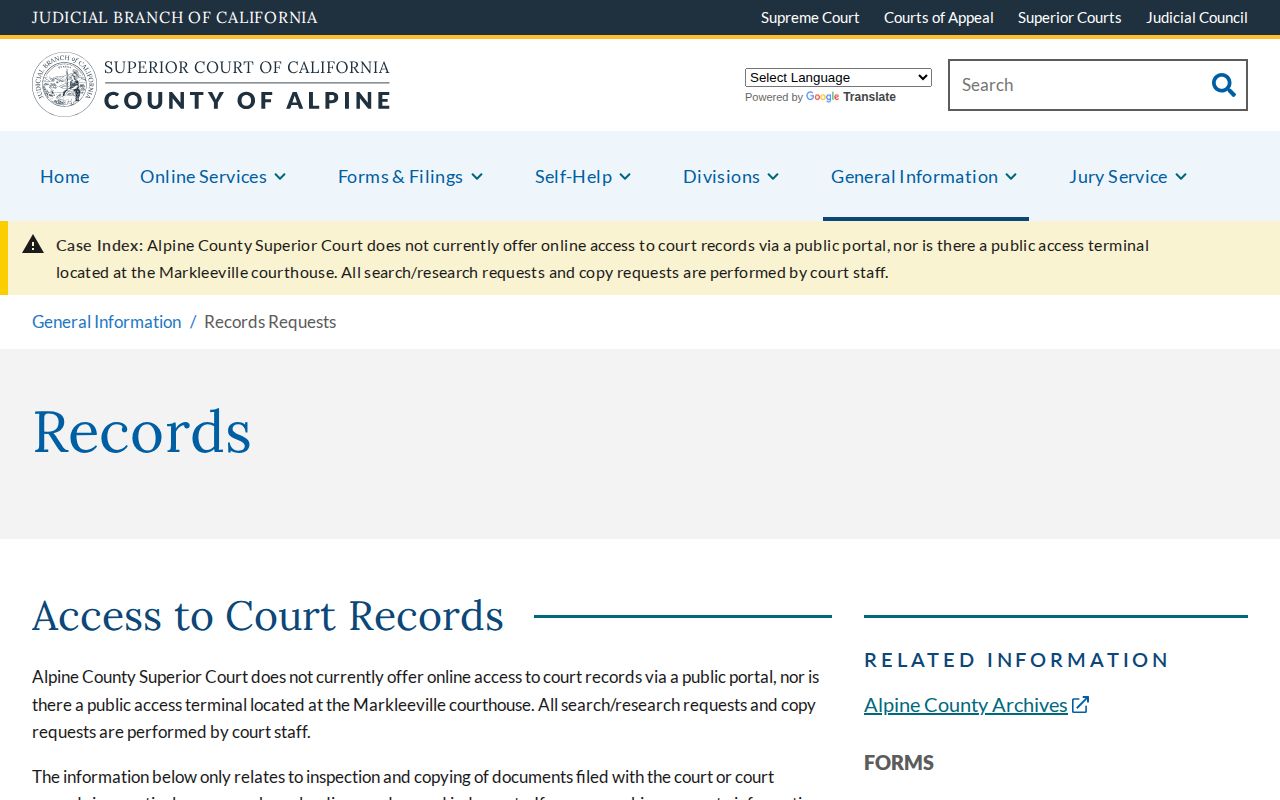
Use the court record for disposition, and the holding jail record for the booking and release timestamp.
Request Alpine Court Records
The court accepts records requests in person, by mail, or by fax. It does not process name-search or copy requests by email. For a release question, ask for criminal minutes, docket entries, bail or release orders, disposition, sentencing orders, probation orders, warrant recall, remand entries, or commitment records. Include enough identifiers to avoid a false match.
- Prepare the full legal name, aliases, and date of birth.
- State the case type and date range if known. The court normally searches back 10 years for name-search requests unless another range is specified.
- Send the request in person, by mail to Alpine County Superior Court, PO Box 518, Markleeville, CA 96120, or by fax to 530-694-2119.
- Ask for records that show release, sentence completion, bail, time served, probation, dismissal, transfer, or commitment.
- Include fees when required and allow extra time if files are off site.
Court Fees and Limits
The court lists a $15 search fee for searches longer than 10 minutes under Government Code section 70627(c), plus $0.50 per page for copies. Name-search requests made at the Clerk's Office counter are not charged the search fee. Some older files may be off site, which can add one to two weeks. Files viewed on premises cannot be removed from designated areas, and phone-camera photos of file contents are not allowed.
| Access issue | Effect on release confirmation |
|---|---|
| No online portal | Staff must perform the court search |
| No public terminal | There is no courthouse self-search computer |
| Juvenile or sealed record | Public access may be barred without an order |
| Automatic record relief | Conviction information granted relief may not be disclosed to the general public |
| Off-site file | Retrieval may add one to two weeks |
Alpine Jail and Court Split
A released Alpine County inmate often has records in more than one place. The jail custodian, such as El Dorado or Calaveras, confirms the booking and physical release. Alpine Sheriff confirms the local arrest or transport. Alpine Superior Court confirms why custody ended and whether the case continued after release. If the court shows a state-prison sentence, use CDCR. If the jail release entry shows ICE, BOP, or another agency, use that system next.
- Release order
- A court direction allowing custody to end under specified terms.
- Disposition
- The court result, such as dismissal, plea, sentence, probation, or commitment.
- Remand
- A court order sending a person into custody, which may precede a later release or transfer.
Note: A court record can explain a release even when a current-inmate search no longer displays the person.
Court Release Examples
Different court entries answer different release questions. A bail or bond order can explain why the jail released a pretrial defendant. An own-recognizance order can show that the court allowed release without a posted bond. A sentence with credit for time served can explain why a person left custody the same day sentence was imposed. A dismissal can explain why custody ended even though the arrest record remains. A probation order can show that physical custody ended while supervision continued.
For felony cases, the court file can also show a state-prison commitment. That does not mean the person was released from all custody. It may mean the person was released from a contract county jail to CDCR transportation or later appeared in CDCR custody. In that case, the Alpine court record is the bridge to CIRIS, CDCR release-date fields, BPH hearing records, or parole supervision. For federal or immigration transfers, the court record may not show the final custodial location, so the jail release entry remains important.
Automatic record relief and sealed records can limit what staff may disclose. The Alpine court records page states that juvenile records are confidential, sealed records require a court order, and some conviction information granted automatic relief is not disclosed to the general public. If staff cannot release a record, the answer may reflect a legal access limit rather than a lack of custody history.
Court Request Checklist
For court release confirmation, identify the person and the case as tightly as possible. Include the full legal name, aliases, date of birth, case number if known, approximate arrest or hearing date, and the kind of record needed. For release research, useful phrases include minutes showing release, bail or own-recognizance order, disposition, sentencing order, probation order, warrant recall, remand, dismissal, time-served entry, or prison commitment. The court does not process name-search or copy requests by email, so use the listed in-person, mail, or fax channels.
Public Record Search
Sponsored Results