
CDCR Releases from Alpine
CDCR is the right system only when an Alpine County defendant was sentenced to state prison or is under state parole. A person who bonded out of an El Dorado or Calaveras jail after an Alpine misdemeanor will not be confirmed through CDCR. A person committed from Alpine Superior Court to state prison may appear in CDCR systems while in custody and may later have parole or discharge records after release.
CIRIS, the California Incarcerated Records and Information Search, is the state offender-search endpoint. The CA.gov service description says CIRIS results include name, CDCR number, age, current location, commitment counties, admission date, and Board of Parole Hearing dates and outcomes for incarcerated persons currently in CDCR custody. The current-custody limit is important. It is not a complete public archive of every former Alpine detainee.
The CDCR CIRIS search page is the official starting point for a state-prison custody check. The screenshot below belongs on this page because it is the statewide release-search channel for prison cases.
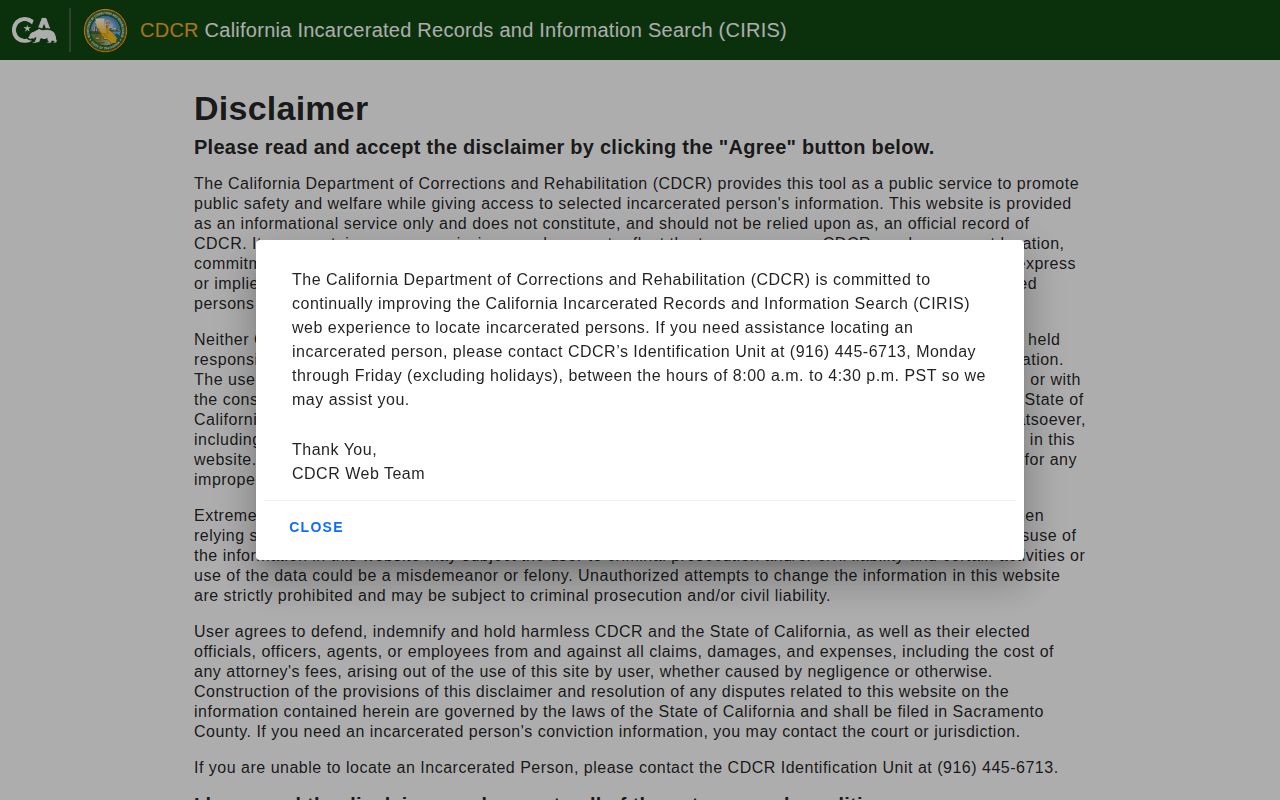
If CIRIS does not resolve the release question, use the CDCR Identification Unit and the sentencing court record.
Confirm a CDCR Release
A CDCR release confirmation requires matching the person to the state-prison record and then tying that record back to the Alpine court case. Name searches can be weak because of aliases, spelling, and common names. CDCR number is stronger. Commitment county helps, but it must be read carefully when a person has more than one case or transfer history.
- Search CIRIS by full legal name and CDCR number if known.
- Review current location, commitment counties, admission date, and BPH data if shown.
- If no result or an unclear result appears, call CDCR Identification Unit at 916-445-6713 during listed business hours.
- Use Alpine Superior Court records to verify the sentence, commitment, disposition, or later court order.
- For a released parolee, look for parole conditions or DAPO supervision information rather than a county jail release list.
CDCR Release Date Fields
CDCR release-date language can be misunderstood. The Good Conduct Credits FAQ uses Earliest Possible Release Date for determinate sentences and Minimum Eligible Parole Date for indeterminate sentences. It also refers to Parole Eligible Date, Elderly Parole Eligible Date, and Nonviolent Parole Eligible Date. These are projected or eligibility dates. They are not always the day a person walks out.
| Field | How to read it |
|---|---|
| EPRD | Earliest possible release date for a determinate sentence, affected by credits and recalculation |
| MEPD | Minimum eligible parole date for indeterminate cases, not automatic release |
| BPH dates | Hearing schedule or outcome information for eligible cases |
| Parole conditions | CDCR says the notice gives the prison release date and maximum parole length |
State Release vs County Release
Alpine's no-jail structure makes the split clear. County or contract-jail release is confirmed through Alpine Sheriff, El Dorado, Calaveras, VINE, and Alpine court records. State-prison release is confirmed through CDCR, DAPO, BPH, and the sentencing court. If a contract jail record says released to CDCR, the county custody ended but state custody began.
Penal Code section 3000 explains that many prison sentences include parole or postrelease community supervision. A person can be released from prison yet remain under supervision. Discharge is a later event that ends the supervision obligation.
CDCR Follow-Up Records
When CIRIS does not give a clear answer, the follow-up record depends on the question. For current state custody, the CDCR Identification Unit is the support channel named in the research. For release-date calculation, CDCR good-conduct-credit material explains EPRD, MEPD, and other eligibility fields. For parole-eligible cases, BPH hearing schedules and results may show whether a suitability hearing was scheduled, granted, denied, or continued. For supervision after release, CDCR parole conditions can show the date released from prison and maximum parole length for the supervised person.
Alpine Superior Court remains part of the stack. The court sentence, minutes, abstract, or disposition can show whether the person was committed to CDCR, sentenced to local custody, placed on probation, released time served, or otherwise disposed. Commitment county in a state search should be read with care because a person can have more than one case, revocation, transfer, or multi-county history. If Alpine is not shown where expected, verify the case number and sentencing court before ruling out the state-prison path.
Do not use CDCR as a substitute for contract jail records. A short jail stay in El Dorado or Calaveras will usually be confirmed by that jail and Alpine court records. CDCR becomes relevant when the release event is state-prison custody, parole, PRCS routing, or a jail transfer to state prison.
CDCR Release Checklist
Before contacting CDCR, gather the full legal name, date of birth, CDCR number if known, Alpine case number, sentencing date, and commitment county shown in the court record. Search CIRIS first for current state custody. If CIRIS is unclear, call the Identification Unit and compare any answer with Alpine Superior Court records. For an indeterminate case, check BPH hearing schedules and results. For a released parolee, use parole conditions or DAPO routing to confirm the supervision layer after prison release.
Public Record Search
Sponsored Results