
Alpine Projected vs Actual Release
A projected release date is an estimate or calculated eligibility point. It is not always the day the person leaves custody. In Alpine County, a local jail sentence is served through a contract jail, so El Dorado or Calaveras may calculate the physical release date. Alpine Superior Court may explain the legal reason through bail, time served, sentence, remand, or transfer entries. CDCR uses different fields for state-prison sentences, and federal custody uses BOP's release-date field.
Actual release is the confirmed event. It shows when the person left a jail, prison, or agency custody and the manner of release. For Alpine cases, ask for the time and manner of release from the holding jail or agency when a projected date has passed or changed.
Lookup Alpine Release Dates
The correct lookup path depends on whether the person is pretrial, sentenced locally, sentenced to CDCR, parole eligible, federal, or transferred. Do not start with CDCR for a person who only bonded out of a contract jail after an Alpine misdemeanor. Do not use a jail release list for a person serving a state-prison sentence.
- Identify the custody type: contract county jail, CDCR, BOP, ICE, or court-only citation release.
- For El Dorado or Calaveras custody, contact the holding jail records unit for calculated release and actual release records.
- For Alpine court events, request court minutes, disposition, sentence, bail, time-served, or transfer entries.
- For state prison, search CDCR CIRIS and call the CDCR Identification Unit if the result is unclear.
- For release alerts, use VINE Inmate Check while custody is active.
- For federal cases, use the BOP locator and BOP about-records guidance.
CDCR CIRIS is a major source for state-prison cases from Alpine County. Open the CDCR CIRIS source.
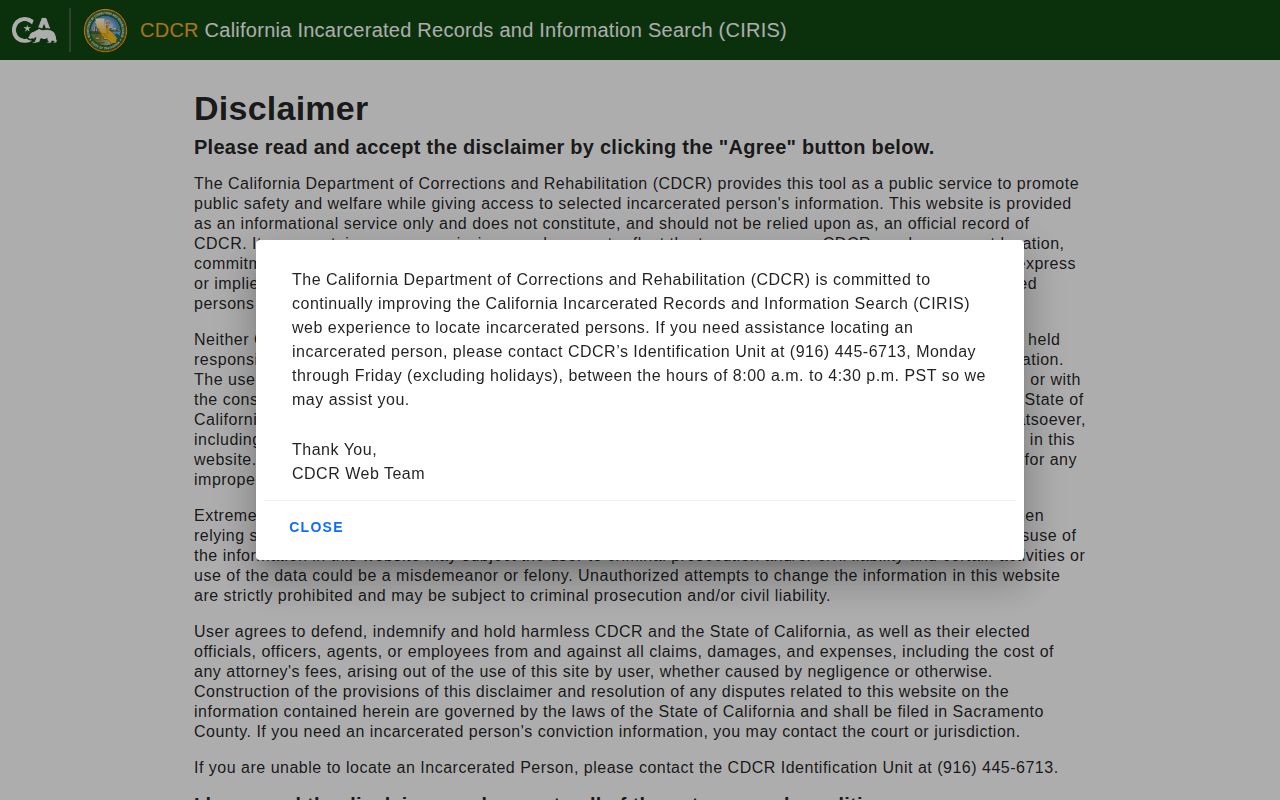
CIRIS is useful for current CDCR custody and commitment information, but it is not a complete archive of people released from Alpine contract jails.
Alpine Release Date Split
Research Section 19 identifies Alpine's release-date computation quirk: local jail dates, CDCR projected or eligibility dates, and federal release dates are separate systems. A user must know the custody type before interpreting any date. The same name can appear in court records, jail records, and state systems at different points in a case.
For a contract jail, the jail calculates the physical release using its records and the court order it receives. The court may have the sentence, credit award, bail order, dismissal, or remand entry. The sheriff may have the arrest and transport record. These pieces often need to be reconciled because Alpine itself does not run the jail. A release date from the holding jail explains when custody ended; the Alpine court file explains why it ended.
For state prison, the date vocabulary changes. CDCR's research-backed fields include Earliest Possible Release Date for determinate sentences and Minimum Eligible Parole Date for indeterminate sentences. Parole Eligible Date, Elderly Parole Eligible Date, and Nonviolent Parole Eligible Date are also eligibility fields where applicable. None should be flattened into one universal "out date."
| Custody type | Date label to expect | Source |
|---|---|---|
| Contract county jail | Calculated release, release date/time, or release reason | El Dorado or Calaveras jail records, Alpine court records. |
| CDCR determinate sentence | Earliest Possible Release Date | CDCR records and good-conduct credit rules. |
| CDCR indeterminate or parole-eligible sentence | Minimum Eligible Parole Date or parole eligible date | CDCR, BPH schedules/results, Penal Code section 3041. |
| Federal custody | BOP release date | BOP inmate locator and BOP about-records page. |
| ICE transfer | Current detention location, not county release date | ICE ODLS plus the county release or transfer record. |
California Good-Time Credits
For many local custody situations, Penal Code section 4019 governs conduct and work credits in county jail and related local confinement settings. For Alpine, the holding county and court records matter because Alpine has no jail. The jail may calculate physical release using actual days, sentence length, credits awarded, holds, warrants, bail changes, and court orders.
For state-prison cases, CDCR's Good Conduct Credits FAQ explains that credits can apply toward the Earliest Possible Release Date for determinate sentences and the Minimum Eligible Parole Date for indeterminate sentences. The same research notes that other parole eligible dates, such as elderly, nonviolent, and youth offender dates, are separate eligibility concepts.
California's violent-felony credit cap is a common source of confusion. Penal Code section 2933.1 limits worktime credit to no more than 15 percent for covered violent felonies and also limits specified presentence local custody credits. That is often described as serving about 85 percent, but it is not a universal California rule.
The CDCR good-conduct screenshot below supports the state-prison credit discussion. Open the CDCR Good Conduct Credits source.
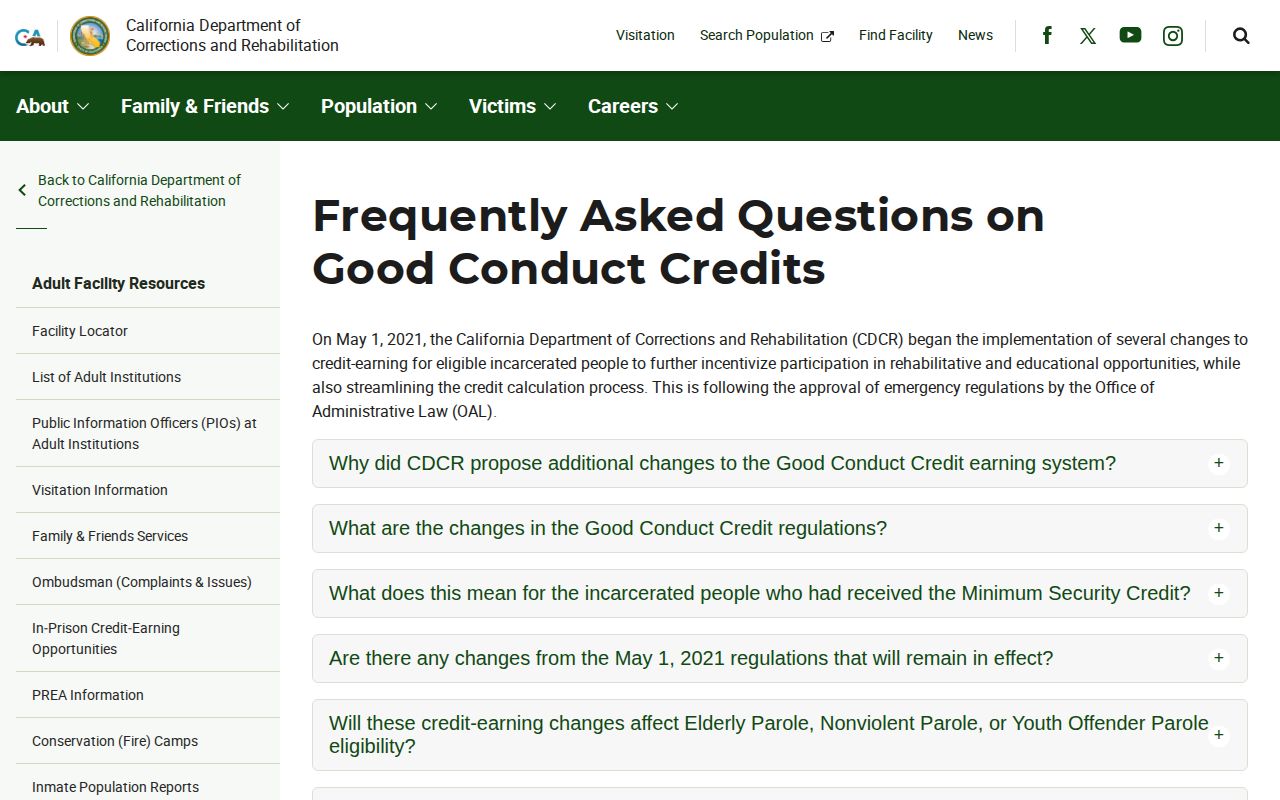
Use the CDCR credit language only for state-prison cases; local contract jail dates require the jail and court calculation.
Why Alpine Dates Change
Projected dates can move for legal, custody, or data reasons. A new hold can block release. A court can remand a person, change bail, correct a sentence, or award credits. Jail discipline or credit correction can alter a local date. CDCR credits, milestone credits, disciplinary losses, resentencing, amended abstracts, or detainers can change a prison date. BOP release dates can also change because of federal sentence reviews and time credits.
| Change factor | Likely record source |
|---|---|
| Bond or bail change | Alpine Superior Court and holding jail. |
| Credit correction | Holding jail for local custody, CDCR for prison custody. |
| Detainer or hold | Jail release record, ICE, USMS, CDCR, or court record. |
| Parole hearing result | Board of Parole Hearings schedules and results. |
| Transfer to another custodian | Time and manner of release from the holding jail. |
Confirm Alpine Release Dates
Confirmation means matching the projected date to a source record. For a local Alpine case, ask the holding jail for the release date, release time, release reason, and transfer destination if any. Ask Alpine Superior Court for the order or disposition that caused the release. For state prison, use CDCR and parole records. For federal custody, use BOP. For immigration transfer, use ICE ODLS only after the county release record shows an ICE path.
VINE is helpful before and around the event because it can send release or transfer alerts. It does not replace the official release record. For post-release supervision status after the date arrives, use Post-Release Supervision.
Pretrial Alpine Release Dates
Pretrial detainees often do not have a fixed release date. The person may be released when bail is posted, when the court orders release, when charges are dismissed, when a hold is cleared, or when another agency takes custody. A contract jail may know the custody status, but the Alpine court record may be the better source for the order that changed it. That is why a pretrial release-date question often becomes a court and records question rather than a calendar lookup.
Ask for the release reason, not just the date. "Released to CDCR," "released to ICE," "released to other agency," "released on bond," and "released time served" all mean different things. If the person is no longer in a current-inmate tool, use the records unit to learn the manner of release. If the court file is needed, Alpine Superior Court requires staff search and does not process name-search or copy requests by email.